By LW Lundstrom, October 13, 2026
This week. I fielded and engaged with three incredible opportunities. And then it hit me. The pattern is recognizable. There are moments in life when you look at what is happening around you and think, wow, Only God knows how this continues to unfold. And Why.
That’s been my week.
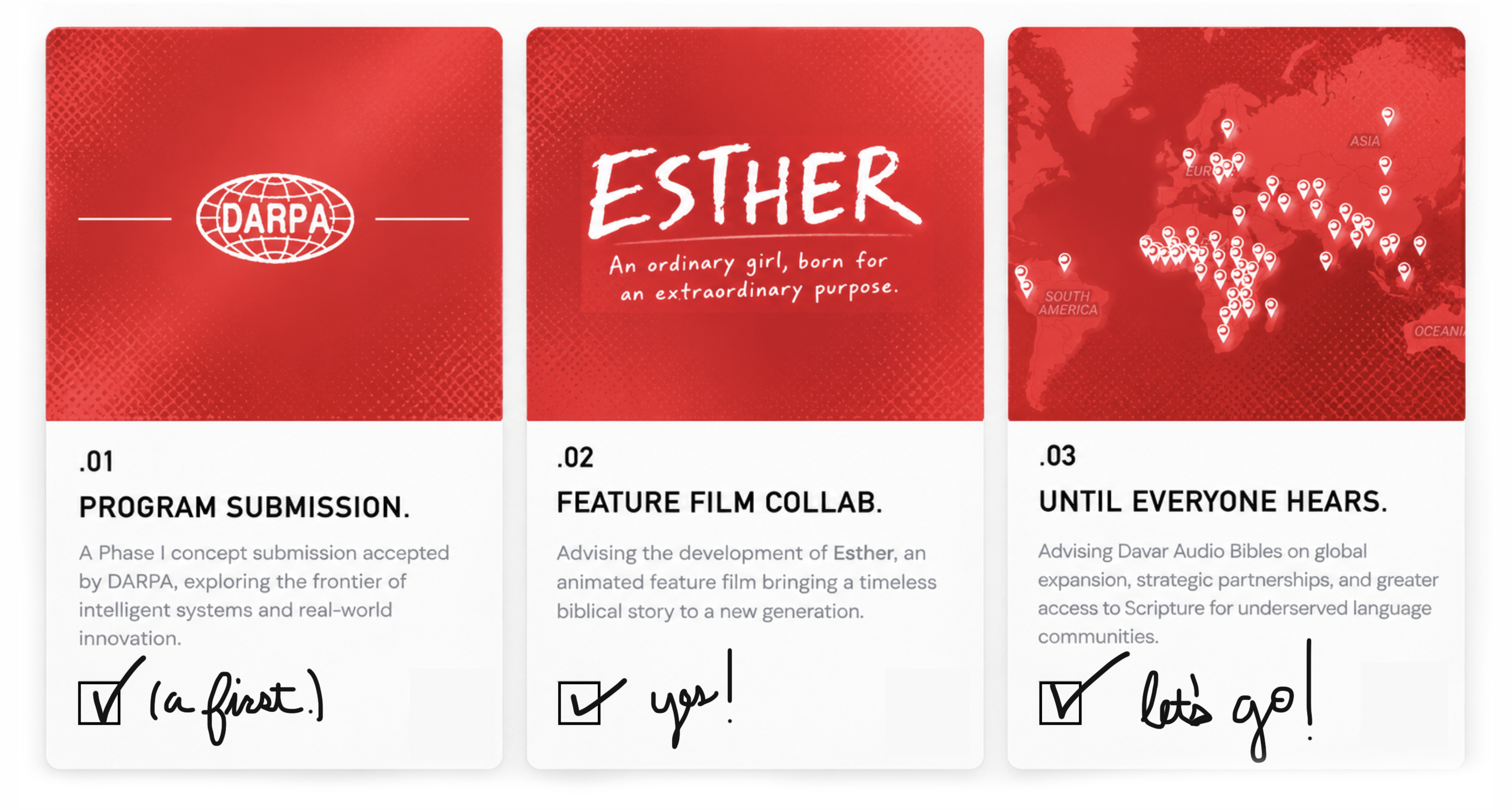
In the span of just a few days, I’ve found myself invited into conversations and projects that seem to have very little in common. A Phase I concept submission accepted by DARPA, exploring the possibilities of intelligent systems and real-world innovation. An opportunity to advise on Esther, an animated feature film bringing one of Scripture’s most remarkable stories to a new generation. And work alongside Davar Audio Bibles, helping explore global expansion, strategic partnerships, and the possibility of reaching people around the world who have never heard God’s Word in their own language.
National defense research. Animated biblical storytelling. Audio Scripture for the nations. Seriously. How do those three things end up in the same week? And yet, strangely enough, there’s a pattern. Looking back over the years, I’ve had opportunities to contribute to work connected with SpaceX and StarLink, to help bring The Chosen to audiences around the world through Come and See, and now to explore new frontiers with DARPA, Esther, and Davar. Technology, media, ministry, innovation, and missions. Different industries. Different people. Different problems worth solving.
I don’t share this to suggest that every conversation becomes a contract, every idea becomes a product, or every opportunity becomes a success story. Anyone who has spent time building something knows better. Most good ideas require far more work than enthusiasm, and plenty never make it off the drawing board. But I do find myself increasingly amazed by the invitations. Especially because I know the parts of my story that aren’t visible in a portfolio or résumé. The failures. The heartbreak. The doors that closed. The times I thought I had finally figured out where God was leading, only to discover that the road was about to take another unexpected turn.
Some of those turns have been painful. Some still are. And perhaps that’s what makes all of this so fascinating to me. God has never seemed particularly interested in following the career plan I would have written for myself.
Thank God for that.
The problem with wanting to know the whole story
I’ve spent a good portion of my life working in leadership, innovation, ministry, and organizational strategy. I’m wired to ask questions. I want to know where we’re going, why it matters, how we’re going to get there, who needs to be involved, and what measurable success should look like.
Frankly, I love that stuff. But here’s the tension. The very instincts that can make someone effective in business and leadership can make trusting God incredibly difficult. We want a strategic plan. God often gives us a next step.We want a timeline. God asks us to wait. We want certainty. God calls us to trust Him. We want to see the outcome before we commit. God asks us to be faithful before we know how the story ends. And I suspect I’m not the only person who struggles with that.
We live in a world obsessed with predicting the future. We build artificial intelligence to recognize patterns, use algorithms to anticipate human behavior, study markets, forecast risks, and analyze enormous amounts of information to give ourselves some sense of control. There’s tremendous value in that work.
But even our most sophisticated technology cannot answer the questions that keep us awake at night. Why am I here? Why did that happen? What am I supposed to do next? Why did that door close? Why did this opportunity arrive now? We may become exceptionally good at predicting what people will do. That doesn’t mean we’ve become any better at understanding what God is doing. And maybe that’s the point.
Ordinary human. Extraordinary purpose.
I’ve been thinking a lot about Esther lately, for obvious reasons. It’s one of the most fascinating stories in the Bible, especially when you consider how little Esther actually knew about what was happening around her. She wasn’t born into an obvious position of influence. She was a young Jewish woman living in a foreign empire. Her life had been shaped by circumstances well beyond her control. And through an extraordinary series of events, she found herself in the palace of the Persian king at precisely the moment her people faced destruction.
What’s remarkable is that Esther didn’t receive a detailed explanation from God. She didn’t have a prophetic timeline spelling out what would happen next. She had an opportunity, an enormous responsibility, and a decision that could cost her life. Her cousin Mordecai challenged her with the words that have echoed through generations:
“And who knows but that you have come to your royal position for such a time as this?” — Esther 4:14, NIV
I love the humility of those two words: Who knows? Mordecai wasn’t claiming to understand every detail of God’s plan. He was recognizing the possibility that Esther’s circumstances had positioned her for a purpose far greater than herself. And Esther still had to decide whether she would act. She called for fasting. She prepared herself. And eventually she made the courageous decision to approach the king, even though doing so could mean her death. Faithfulness didn’t remove the risk. t gave her the courage to face it.
I think we’ve sometimes turned the phrase “for such a time as this” into a slogan about personal significance, as though every unexpected opportunity proves we’re destined for greatness. But that’s not really Esther’s story. The story isn’t about a woman discovering how important she is. It’s about a woman recognizing that her position might be an opportunity to serve and save others. There’s a difference. And it’s a pretty important one.
Maybe the assignment is bigger than the opportunity
When I think about SpaceX, The Chosen, Come and See, DARPA, Esther, and Davar Audio Bibles, the obvious common denominator isn’t an industry. It’s not even a particular type of organization. It’s the possibility of helping people accomplish something that once seemed extraordinarily difficult.Connecting communities through technology. Bringing the story of Jesus across geographic and language barriers. Exploring ideas that might solve complicated problems. Helping an ancient biblical story find a new generation of listeners. Making Scripture accessible to people who might otherwise never hear it.
I’m fascinated by the intersection of big ideas and meaningful purpose. But there’s another side to this that I don’t want to miss. The size of an opportunity is not necessarily the measure of its importance to God. A conversation with someone who’s struggling. An afternoon spent encouraging a young leader. An ordinary act of generosity. A moment of humility when every instinct tells you to defend yourself. Being present with your family when your mind is racing toward the next big thing. Those moments won’t appear on a website alongside a DARPA concept or a global media initiative. They may be the most important assignments we ever receive. Jesus never taught that faithfulness was measured by audience size, revenue, influence, or access to important people. His teaching repeatedly pointed toward faithfulness in what has been entrusted to us, whether little or much.
That’s challenging for people like me, because I love building things. I love momentum. I love impossible ideas becoming possible. But I’m learning that God is interested in far more than what I can build. He’s interested in who I’m becoming. And sometimes He does His deepest work in the seasons when things appear to be falling apart.
The closed doors matter, too. But that’s for another time.
LW Lundstrom
Founder, CLLCTV Agency — Working at the intersection of innovation, storytelling, strategic growth, and the mission of making Jesus known.

