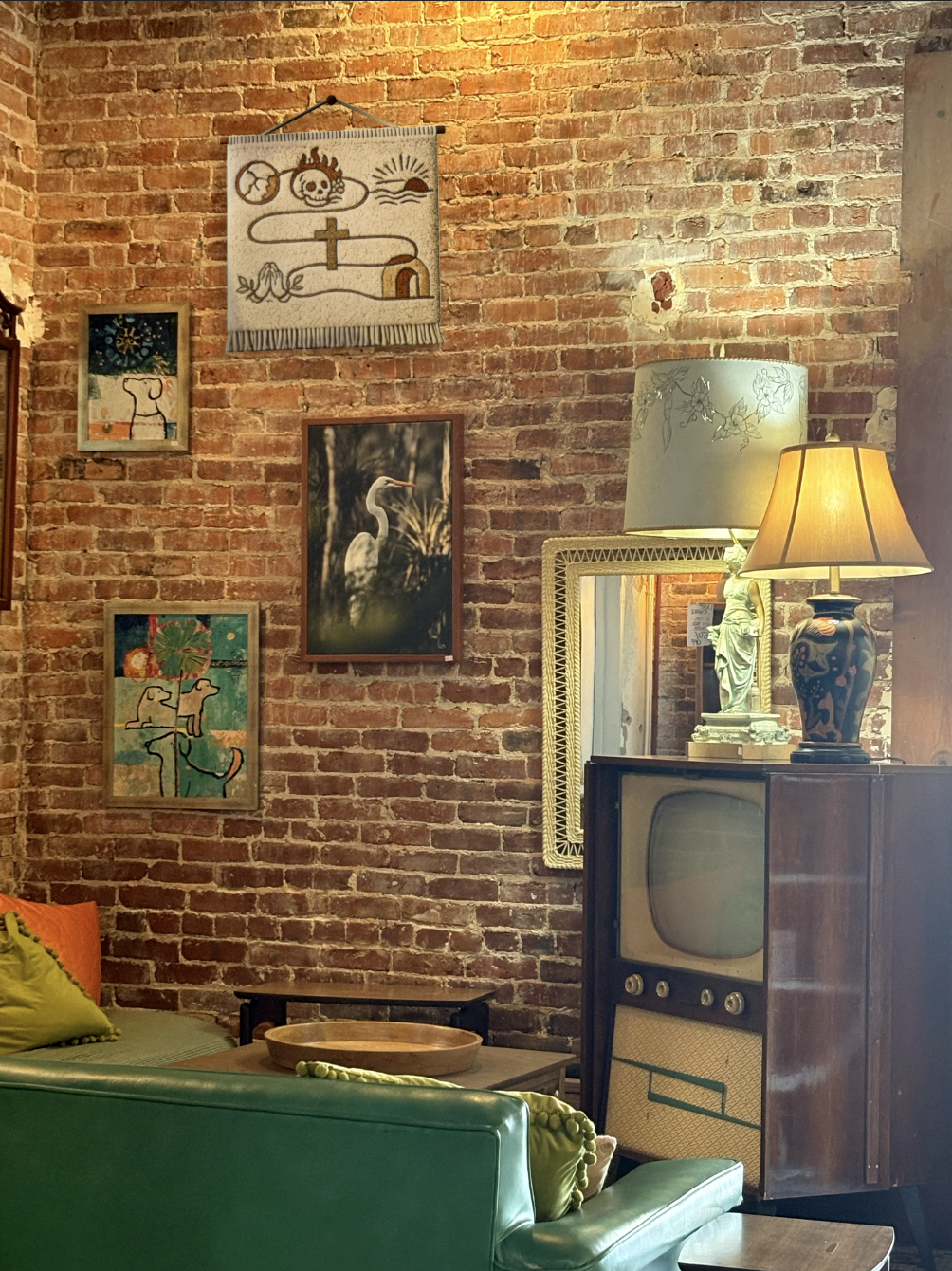
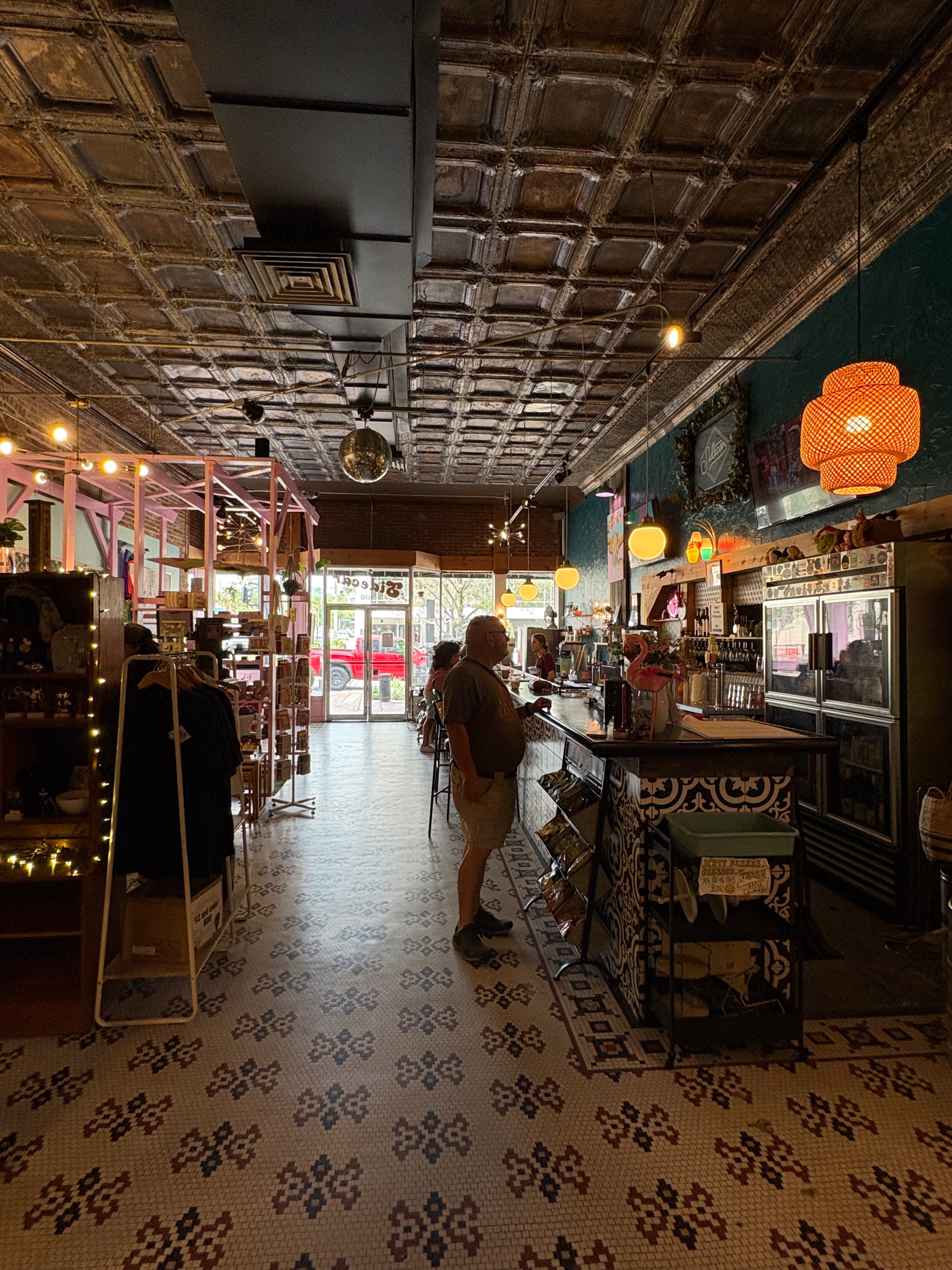
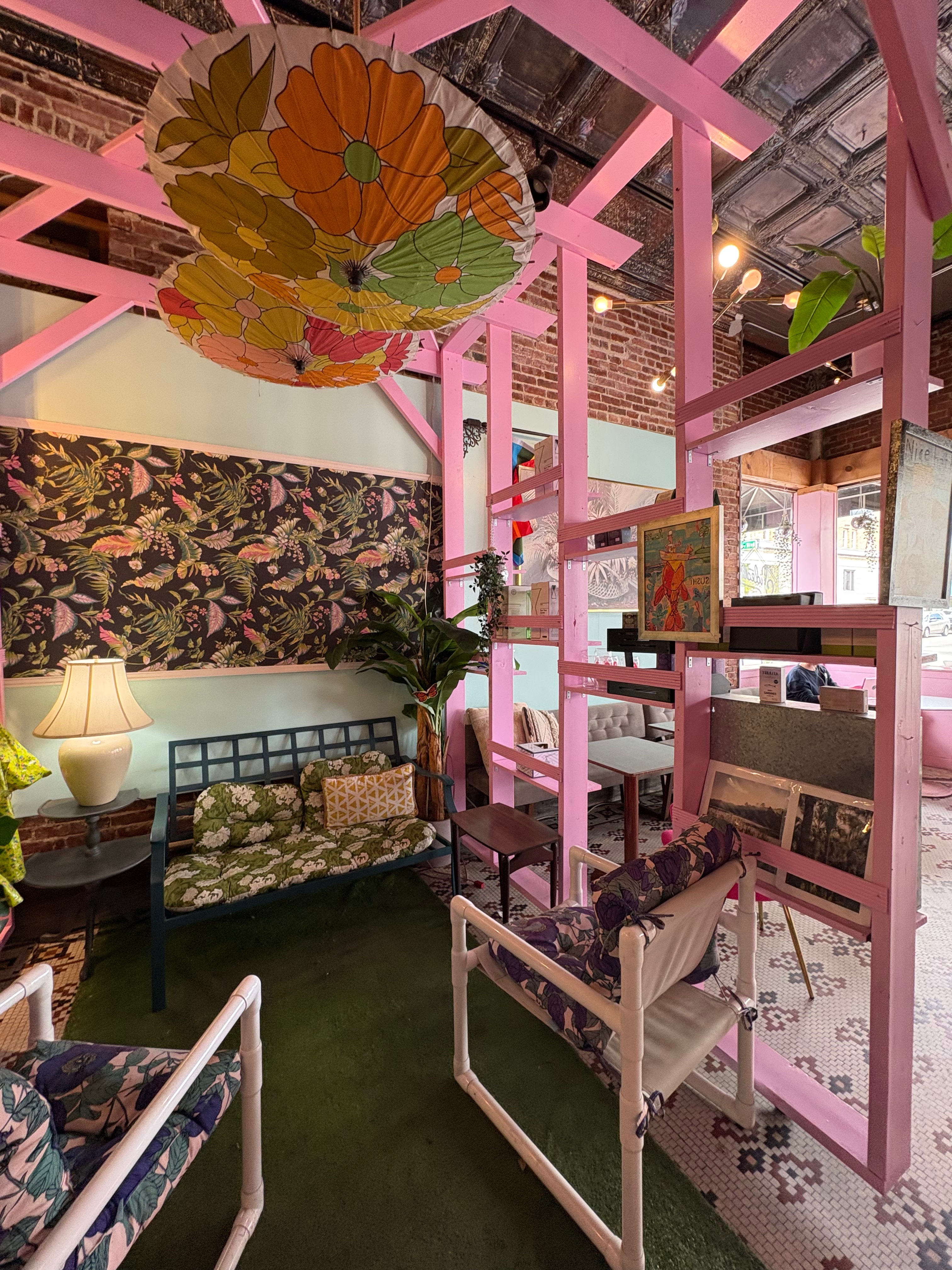
There’s something about old brick walls and warm lamp light that slows the soul down. The kind of place where the espresso machine hums like background music, conversations blur into soft static, and time stops trying to impress you. That’s where I found myself—working remotely in one of my favorite local cafés in DeLand, Florida—when the tapestry on the wall quietly caught my attention. It wasn’t loud or oversized. It didn’t demand anything. It just hung there, almost as if it had been waiting for someone to notice.
At first glance, it looked like a simple 70s-boho wall hanging—minimal lines, earthy tones, handmade texture. The kind of piece that fits naturally into a room filled with vintage lamps, worn wood, and an old television cabinet that feels more like furniture than technology. But the longer I sat there, laptop open and coffee slowly cooling, the more I realized it wasn’t just décor. It was theology stitched into thread. And not just theology—it was the Romans Road, quietly mapped out in symbols for anyone willing to slow down long enough to see it.
At the top left of the tapestry, a fractured circle—something whole, now cracked—immediately pulled me in. It felt honest. No polish. No pretending. Just brokenness. It brought to mind the starting point of the Romans Road: “For all have sinned and fall short of the glory of God” (Romans 3:23). There’s no sugar coating in that verse, and there’s no sugar coating in that symbol. Humanity is broken—every one of us—and the artwork doesn’t try to soften it. Sitting there watching people come and go, I couldn’t help but think that every person in that café carried some version of that crack. Some visible, some hidden, all real.
Next to it, a skull with flames. Stark. Direct. Not subtle. It echoed the next step: “For the wages of sin is death…” (Romans 6:23a). The Romans Road doesn’t soften the consequence either. Sin leads somewhere. It isn’t neutral. The skull in the tapestry isn’t meant to shock; it’s meant to be truthful. It’s a reminder that brokenness isn’t just philosophical—it has an outcome. And yet, even as I absorbed that weight, I noticed the artwork didn’t end there. It kept moving.
Right in the center sat the cross—bold, simple, unmistakable. Everything in the composition seemed to flow toward it. That’s the turning point, the interruption of the inevitable: “But God demonstrates his own love for us in this: While we were still sinners, Christ died for us” (Romans 5:8). The cross doesn’t appear at the beginning of the tapestry. It appears after the reality of sin and death, which is exactly how the Gospel works. The good news only makes sense when you understand what it’s rescuing you from. And there I was in that quiet café, typing emails, planning projects, thinking about partnerships, and realizing again that the center of everything isn’t productivity—it’s redemption.
A winding line stretched across the tapestry, connecting each symbol like a gentle path. It wasn’t chaotic or overly complex. Just steady, purposeful movement. It mirrored the response described in Romans 10:9: “If you declare with your mouth, ‘Jesus is Lord,’ and believe in your heart that God raised him from the dead, you will be saved.” The line felt like an invitation—believe, confess, follow. Salvation isn’t confusion. It’s clarity. The road is there, simple enough for anyone willing to walk it.
On the far right, a rising sun. Quiet hope. No drama. Just steady light breaking the horizon. It brought the Romans Road to its conclusion: “Everyone who calls on the name of the Lord will be saved” (Romans 10:13). The sunrise symbolized what comes after—new life. Not just rescue, but renewal. Morning after night. Grace after consequence. Life after death. It wasn’t loud optimism; it was calm assurance.
I spend a lot of time working remotely in cafés around DeLand. It’s where ideas form, strategies take shape, and honestly, where God often grabs my attention when I least expect it. This wasn’t a sermon. No stage. No pulpit. Just coffee, brick, and thread. But that’s the beauty of the Gospel—it shows up anywhere. Local cafés are crossroads. Students, retirees, families, entrepreneurs, pastors, doubters—all sharing the same room. And sitting there, looking at that tapestry, I realized the Romans Road isn’t just a theological outline. It’s the story of every person walking through those doors: brokenness, consequence, the cross, a decision, new life.
What struck me most is that the artwork never used words. No verses. No explanations. Just symbols. Yet the message was unmistakable. Sometimes the most compelling witness isn’t loud—it’s thoughtful. It’s creative. It’s woven into everyday life. God doesn’t need a spotlight. He uses brick walls, old televisions, warm lamps, and hand-stitched art to tell the greatest story ever told.
Or maybe… I didn’t just discover it — maybe I/we are being invited to make it.
 The Collective Agency : : Marketing, Creative & Innovation for Faith-Based Impact