Recently, I walked alongside a church that took a fresh look at its weekly email bulletin. Nothing radical. Just intentional thinking, pastoral awareness, and a desire to communicate more clearly and more compassionately. The result was surprising. The email stopped feeling like an administrative update and started functioning like ministry. It began doing what church communication is meant to do: invite, guide, and nurture people toward deeper connection with Christ and His body.
The truth is, most church emails follow a familiar pattern. A logo at the top. A banner. A list of announcements. Some links. Maybe a Scripture. Maybe a closing blessing. On paper, everything is there. But emotionally, very little is happening. They answer the question, “What’s happening this week?” without ever addressing the deeper question people are actually asking: “Do I belong here?” People always move toward meaning before they move toward meetings. If our communication doesn’t carry meaning, it won’t carry people very far.
Before the redesign, this church’s email was sincere and functional. It included a map background, service time, location, seasonal promotions, and contact information. Technically, it was complete. Spiritually and relationally, however, it felt distant. There were no faces. No sense of story. No glimpse of community. It felt more like a flyer than a family update. It communicated, “Here’s where we meet,” but not, “Here’s who we are.” That difference may seem subtle, but it is the difference between information and invitation.
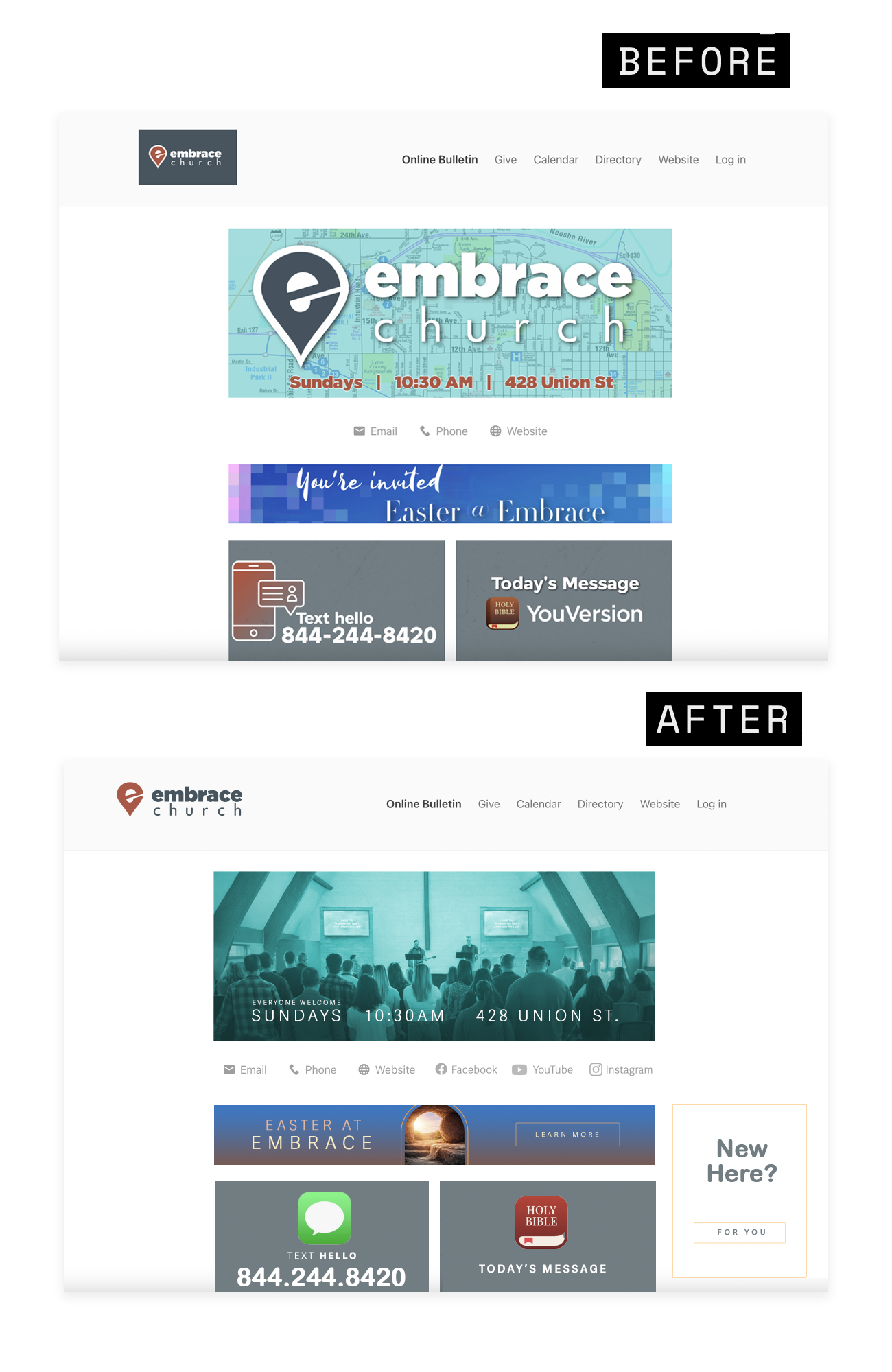
The redesign began with one simple but signifigant shift: people before places. The map background was replaced with a real photograph of the congregation gathered in worship. Suddenly, readers weren’t looking at streets and blocks. They were looking at brothers and sisters standing together before the Lord. They could see themselves there. They could imagine being part of that moment. That single change raised the emotional temperature of the entire email. It moved from cold to warm, from distant to relational, from institutional to pastoral. People do not join churches because of geography. They join because they sense belonging.
The second shift focused on pathways instead of posters. Previously, seasonal promotions like Easter were announced with generic banners and minimal direction. After the redesign, those same moments were framed with purpose and accompanied by clear “Learn More” buttons. This may seem minor, but it reflects deep discipleship wisdom. Announcements inform. Pathways shepherd. When you give people a clear next step, you honor spiritual momentum. You recognize that the Holy Spirit may already be stirring something in their hearts, and you provide a way for them to respond. Good design, in this sense, becomes pastoral care.
The third shift emphasized connection over consumption. Social links and digital touchpoints were added intentionally, not to promote platforms, but to extend relationships. Now, readers could watch sermons, follow ministry updates, engage throughout the week, and stay connected beyond Sunday. This reflects a fundamental theological truth: the church is not an event; it is a body. If our digital systems only support attendance, we are under-serving discipleship. But when they support relationship, they become tools for formation.
One of the most overlooked outcomes of this redesign was trust. Design communicates credibility long before theology is heard. First-time guests may never say it aloud, but they are asking: Is this church healthy? Is it organized? Do they care? Is this place safe for my family? Are these leaders intentional? When communication is clear, warm, and thoughtful, it answers those questions positively. It builds confidence. And confident churches invite courageous faith.
Some leaders hesitate when conversations turn toward branding, design, or aesthetics. They worry about appearing worldly or superficial. But Scripture shows us that God values clarity, beauty, and intentional communication. Jesus told stories. He used images. He spoke in ways people could understand. He met people where they were. That was not marketing. That was ministry. Every email you send carries theology. Every layout reflects values. Every button communicates priorities. Whether you intend it or not, your digital presence is discipling people.
Before the redesign, this email functioned in maintenance mode. It kept systems running. It preserved routines. It supported habits. Afterward, it began functioning in mission mode. It invited people. It guided decisions. It encouraged participation. It created pathways for growth. This is what leadership looks like in a digital age. Not louder communication, but wiser communication. Not more content, but clearer purpose.
For pastors and communications leaders, this raises important questions. Does our communication feel like family or like a flyer? Can people instinctively see their next step? Are we showing real faces or hiding behind graphics? Does what we send reflect where God is leading us, or where we’ve always been? Your digital presence is preaching a sermon every week. The question is whether you’re aware of what it’s saying.
The encouraging truth is that transformation does not require massive resources. Small, faithful upgrades compound over time. A short welcome line that says, “We’re glad you’re here.” A simple “New Here?” page with a pastoral video. A thirty-second smartphone greeting from a leader. Stronger subject lines that honor people’s limited attention. These are not marketing tricks. They are acts of hospitality.
To pastors in particular, this is worth emphasizing: you are not called to be designers. You are called to be stewards. Every message you release reflects your shepherding. Every layout communicates leadership. Every system reveals priorities. Digital ministry is not separate from spiritual ministry. It is one of its modern expressions. When communication is clear, people feel safe. When it is warm, people feel seen. When pathways are strong, people grow. That is discipleship.
The ultimate goal of this redesign was not prettier emails. It was stronger bridges. Bridges from curiosity to community. From attendance to discipleship. From information to transformation. When church communication accomplishes that, it becomes more than a tool. It becomes a ministry platform through which God works quietly, faithfully, and consistently in people’s lives.
In a world saturated with noise, faithful clarity is a gift. In a culture marked by disconnection, intentional communication is pastoral care. When churches steward these realities well, they honor both the Gospel and the people God has entrusted to them.
That is work worth doing well.
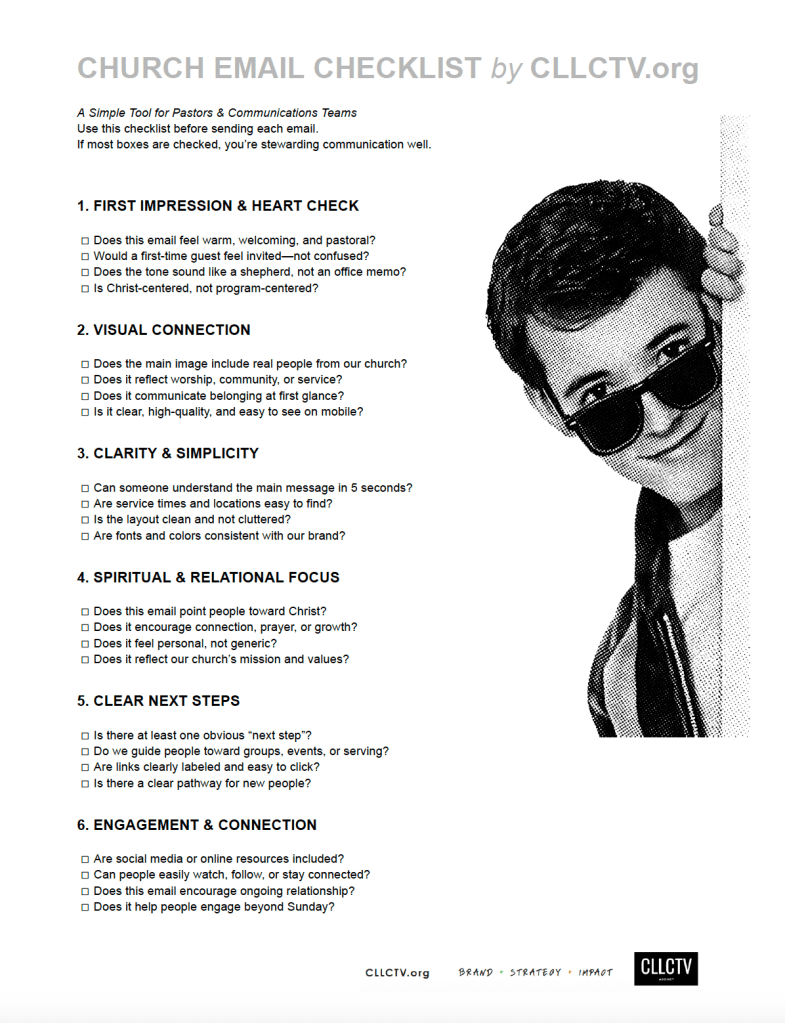
Download the Church Email Review: Anyone? Anyone? Checklist.
Need your ministry email reviewed?
If you’d like a review of your current email or newsletter, forward at copy to larry@cllctv.org.
 The Collective Agency : : Marketing, Creative & Innovation for Faith-Based Impact