If you’ve been following you’ve likely seen the recent media coverage of .ai tools, ChatGPT and Tome.app software. Why all the coverage?
First, these tools are expected to disrupt the creative and tech space, not to mention the talent and workforce over the next five to ten years. Controversy and fear are ideal hype tools. But, here’s what’s really happening. Investors are racing to see which .ai software is going to break into the top three and this is where excitement and competition come in.
Want to know more about how we’ve been able to get our story in front of millions of subscribers?
Let’s talk. I’ve got space in the calendar.
Latest news features and subscriber audience:
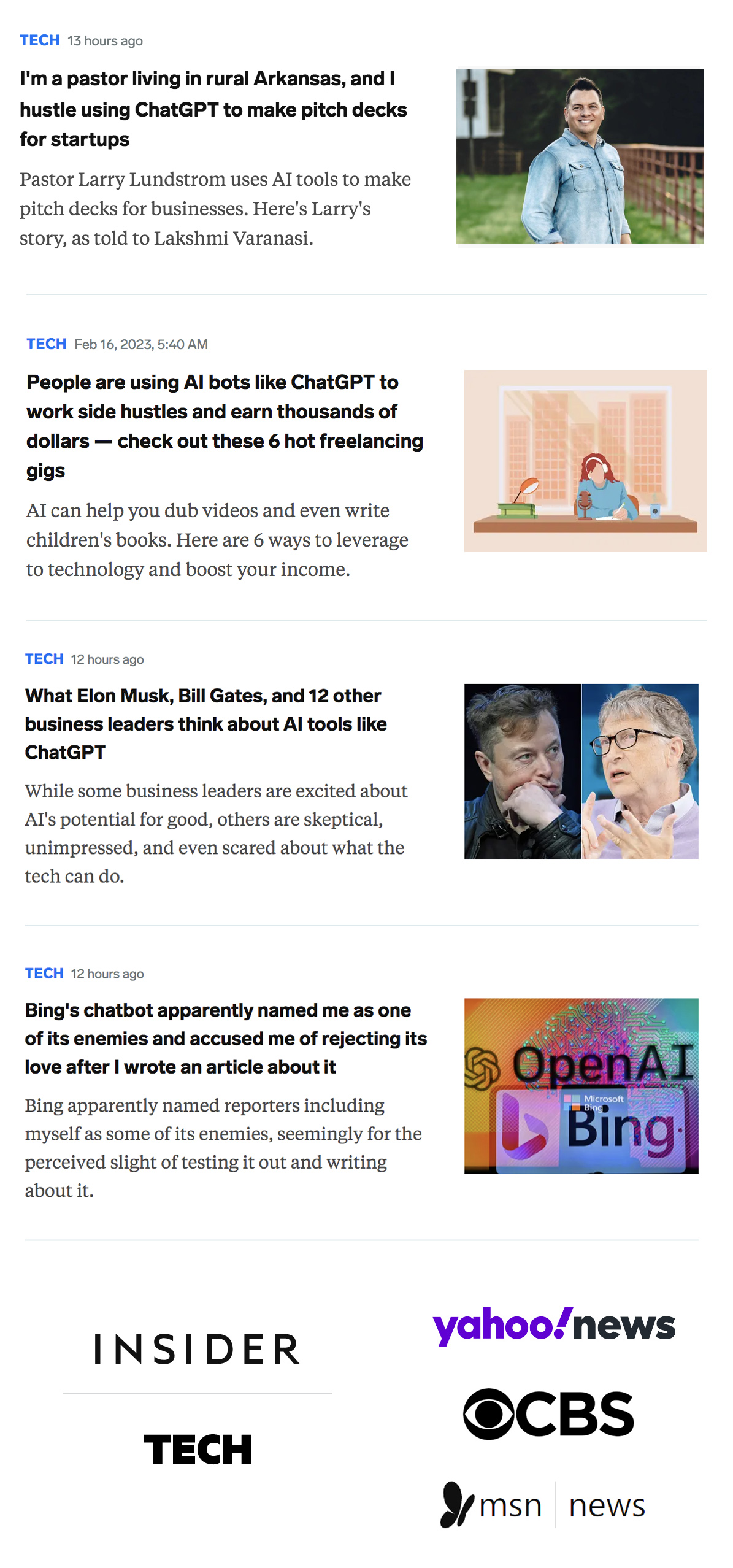
- MSN News — 140M subscribers
- Yahoo News — 1.1M subscribers
- Business Insider — 1M subscribers
Twitter @lundstrategy
Insta @larry.lundstrom
LinkedIn larrylundstrom
- Founder GiveThemHeaven.org
- Founder Optimedia, Sold to Publicis
Raised 50M+ in VC for new tech & innovative organizations. How do pitch decks help gain capital or a book deal? Request consulting.
Pastor in remote Arkansas using .ai in projects

I’ve spent the majority of my career with a pretty idiosyncratic job title: innovation pastor.
There are just a few of us around the nation — around the world, really.
What it means is that I’m an ordained pastor, so I officiate weddings, conduct funerals, and preach sermons.
But I’ve also spent years developing marketing campaigns, building websites, and running the design department of the church.
I spend about 40 to 60 hours a week as a pastor, and I devote the bulk of that time meeting with church members, people in our community, creative projects and of course the weekly sermon.
But I spend another 10 to 20 hours on creative side projects. Oftentimes, that involves making pitch decks, logos, or websites for businesses. My clients range from companies like Elon Musk’s SpaceX to the fintech startup Chime.
For years, Microsoft PowerPoint and Adobe InDesign were my default tools. Now, I’m relying on AI tools like the new chatbot, ChatGPT, and the storytelling tool, Tome, for my creative work.
These tools are worthwhile if you can maintain balance and not rely on them as shortcuts. Ultimately, what’s important is that your work stays true to who you are.
It all comes back to “creation”
I grew up in a household of faith. My grandmother and mother were women of faith, but they didn’t beat me over the head with it.
It was my decision to believe in God.
I chose to believe that someone created the mountains; that someone created our ability to see — and that someone created our ability to create.
It’s funny how it all boils down to that idea of creation. In a way, creation has been a central topic of my entire life. I’ve always thought of myself as a creator — an artist, really.
I’ve been designing logos and graphics since I was in high school. In college, I started building websites, and soon, I got pretty good at that, too.
Yet the dots between my faith and my work didn’t really connect until I became a father. When my son, Colby, was just three years old he stopped walking out of the blue.
A few weeks later, he was diagnosed with leukemia. He died 11 days later.
It was one of those moments where time stopped, and my priorities suddenly changed. I realized that I could do the same work I was doing for the church instead of a marketing firm. So, I left the corporate world, and a new chapter began.
AI tools have cut my turnaround time in half.
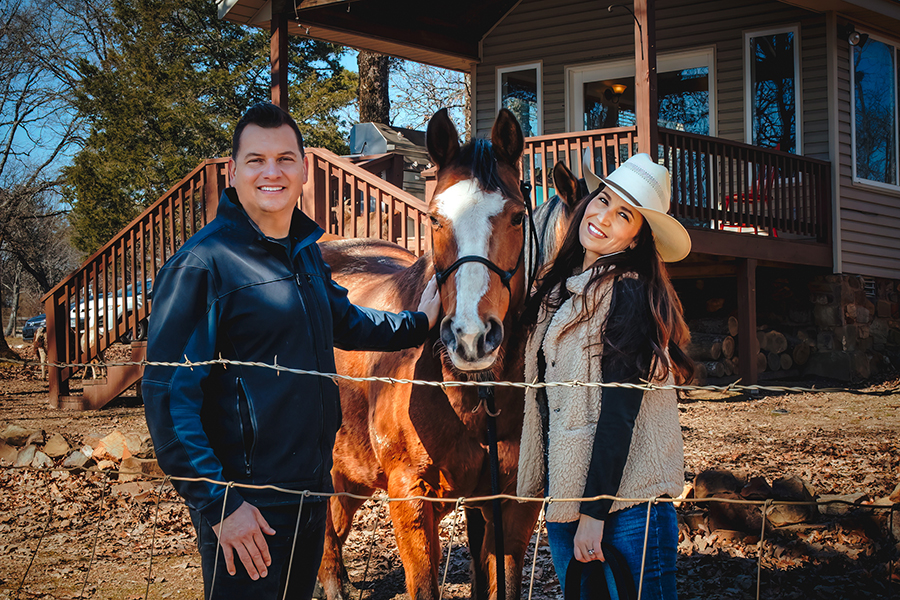
Larry Lundstrom and his wife, Myra, in front of their home in Arkansas.
After years of designing everything from websites to college football logos, my creative work is now limited to freelancing.
I use sites like Upwork to advertise my skills. I also have a Rolodex of clients I’ve built up over my career that still commission projects from me.
Before the dawn of AI tools it would probably take me a week — a full 40 hours — to put together a pitch deck from start to finish.
Now, I can pull together a deck in half of that time. AI tools have made my creative process more efficient. I spend more time on the facets of my work that make the most difference to my client or audience.
I charge between $500 to $1,000 for a deck and I make two to three per week.
To me, it’s not really about the money, though. It’s about having a side hustle that keeps me financially stable and lets me focus on what really matters: staying creative.
More about Larry & Myra Lundstrom

Twitter @lundstrategy
Insta @larry.lundstrom
LinkedIn larrylundstrom
- Founder GiveThemHeaven.org
- Founder Optimedia, Sold to Publicis
Raised 50M+ in VC for new tech & innovative organizations. How do pitch decks help gain capital or a book deal? Request consulting.
 The Collective Agency : : Marketing, Creative & Innovation for Faith-Based Impact
Reblogged this on Lund and commented:
Pastors and ministries around the country continue to reach out to talk about how to launch their project. Who knew? Pitch decks and the church. It’s all about Kingdom expansion.
Could there possibly be a trend happening where non-profits are moving toward the investing space for fundraising?
Stay tuned.
I am know focused full-time at WaterMission.org but still love the convo ministry effectiveness and new innovation. Let me know your thoughts.